
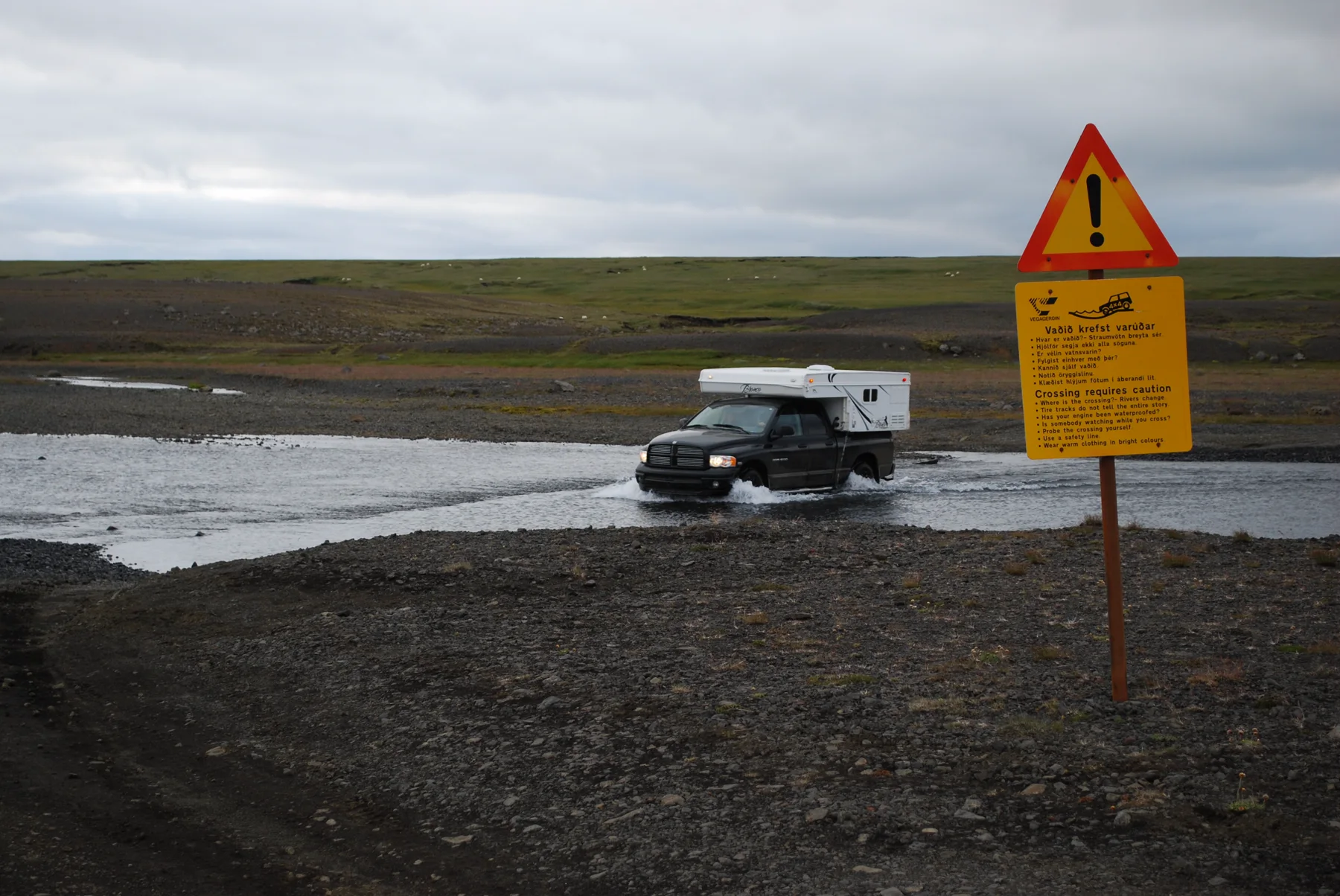
ICENAVI · F-ROAD & RIVER DECISION
Confirm the exit before asking whether the 4WD can cross
This check brings together road opening, vehicle and rental terms, the river exit, driver condition, insurance exclusions and the option of travelling with a driver. It is not wading training, a same-day water report or an insurance promise. If any one category is zero, stop before the river.
Before crossing, the conditions that must align are the road, vehicle, agreement, river exit, driver condition and the route for the following day.
An F-road's opening dates are only background. The official status on your departure day, river, weather and signs at the site decide whether you can approach today.
A 4WD badge cannot replace ground clearance, underbody protection, the F-road list, tyres or written confirmation from the supplier; “or equivalent” still needs checking.
You have a recoverable option only if you can see the route, exit and turning space on the far bank before entering. If you cannot see them, do not enter.
Fatigue, short daylight, a long return or a fixed activity the next day can turn “possible today” into “not worth it”. An accommodation buffer is more useful than one extra spur road.
Water damage is usually a major exclusion. Giving a Highland day to an experienced driver, or choosing a route without a crossing, may be more controllable than accepting one vehicle-damage claim.
Many travellers picture an F-road as a rougher highway: rent an SUV, zoom in on the map and drive slowly. In reality, the F-road classification can include unbridged rivers, and F2 and F3 roads make different demands on a vehicle. The 4WD you see at pickup in Reykjavík may not have the ground clearance, underbody protection or rental permission needed for a particular Highland road.
The more difficult situation is often not a powerful current but a crossing that looks as though it might be fine. A vehicle ahead has reached the far bank, your companions have secured the luggage and cameras, and the light is starting to fade. The pressure is then less about driving technique than sunk cost. The sections below separate the checks you need to complete first, so “do not enter” remains a reasoned choice.
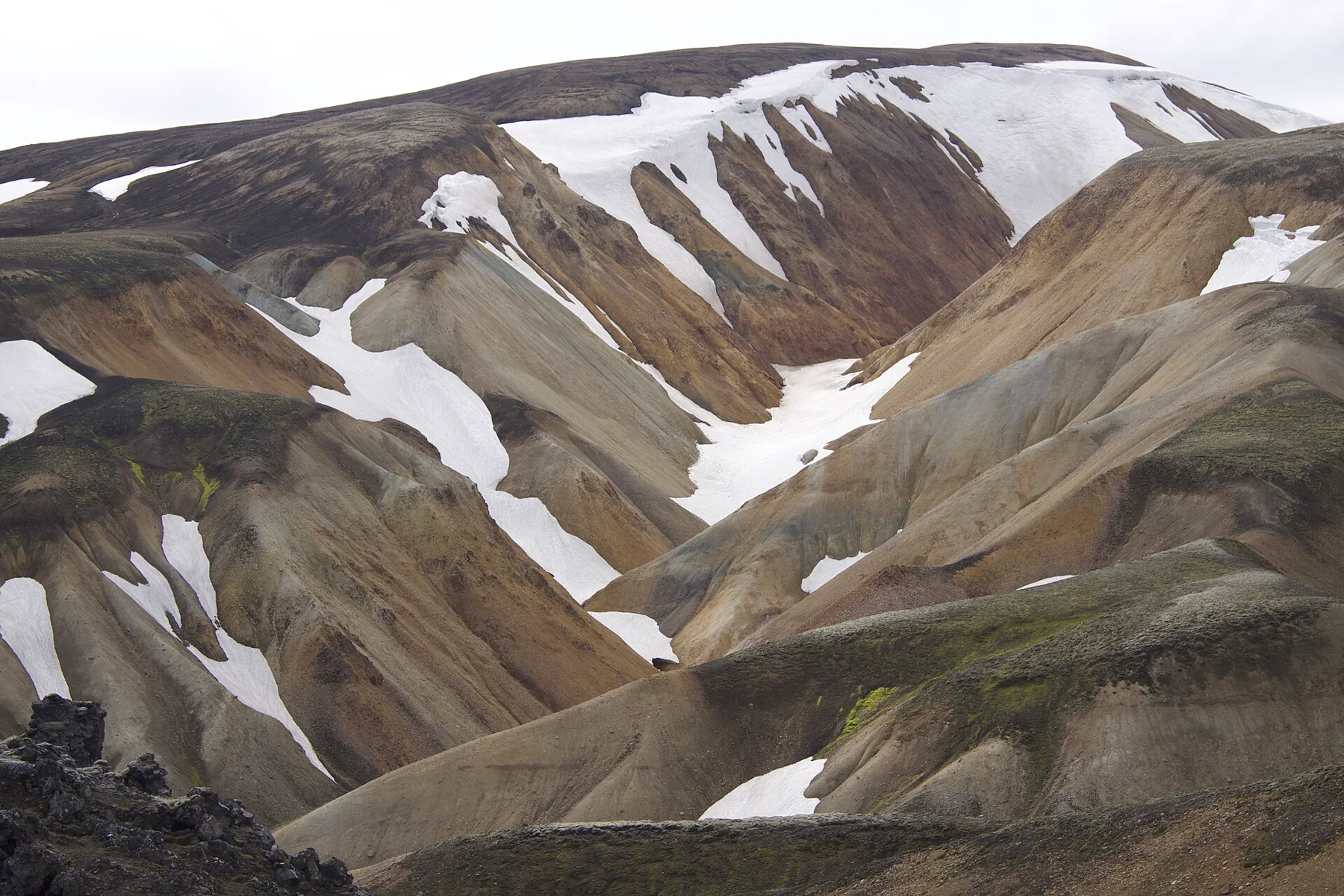
Landmannalaugar approaches: separate the Highland routes before making the river crossing call
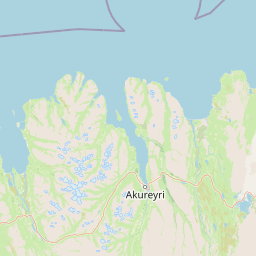
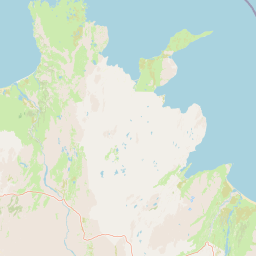
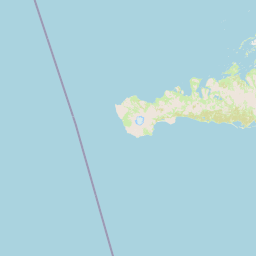
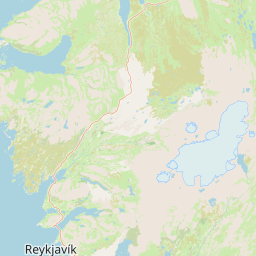
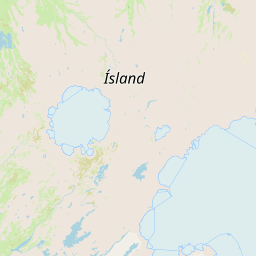
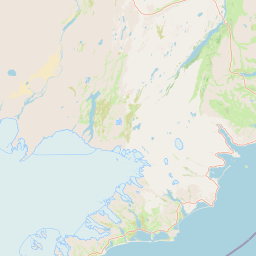
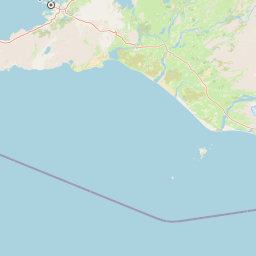
First decide whether you are allowed to enter; only then decide whether you feel confident enough
These questions are often treated as one. The road authority divides F1, F2 and F3 into different levels of difficulty, and SafeTravel notes that not every 4WD suits every F-road; a rental agreement may prohibit particular roads or water crossings. Even if you feel technically confident, an unopened road or a vehicle outside the agreement means the answer is still no.
| Question to answer | Information to check | What the information tells you | What you still cannot infer |
|---|---|---|---|
| Is the road open today? | Umferðin / road-authority opening and closure notices; check again on departure day | Whether the authorities permit general traffic to enter | Opening does not tell you today's depth, speed or ability to cross |
| Is the vehicle genuinely suitable? | Ground clearance, drivetrain, rental-road list and written supplier confirmation | Whether the vehicle and contractual responsibility match | A 4WD badge does not make every F-road or river crossing passable |
| Does the insurance cover water? | Rental exclusions for water damage, underbody, tyres, wading and recovery | Who may carry the cost if something goes wrong | That basic, added or credit-card cover will pay |
| Can I turn around safely? | Inspect the approach, exit, riverbed and far-bank route before entering, and keep a way back | That you still have an executable exit option before entering the water | That the vehicle ahead, an online video or yesterday's water level represents today |
Official information can tell you what to check first; it cannot make the crossing for you. Glacial rivers can change depth and speed within a day, and calm-looking water may conceal boulders or a strong current. This is the upstream version of replanning after a road closure: keep an exit before committing to a sight. If you are reading the rental terms line by line before paying, how to read an Iceland car-rental contract brings the deposit, excess, road eligibility and water exclusions back to one clear risk boundary.
The ten seconds before a crossing are not a courage test
SafeTravel's advice is specific: if you are unsure, do not cross; when a crossing is necessary, first identify the route on the far bank, use a low gear at a steady speed, do not change gear in the water, and watch the downstream direction and submerged rocks. This is safety guidance, not a substitute for personal driving instruction. Anyone without river-crossing experience should not use online video to fill that gap; change the Highland day to a bus or driver-led option and let the driver assess the vehicle and water conditions.
| What you see on site | Do this first | Can you continue? | How I would judge it |
|---|---|---|---|
| A warning sign stands before the crossing and the flow is visible | Stop, read the sign and check the rental terms; do not nose the vehicle towards the water | Only proceed to the next check if the road, vehicle, agreement and day's conditions all align | A warning sign is a work list, not a promise that you can get across slowly |
| You cannot see the driving route on the far bank | Return to a safe position, check official information or find an experienced local driver | Do not enter; without an exit there is no recoverable plan | Not seeing the exit is enough to stop, even before you know the depth |
| The vehicle ahead crossed, but the water level or weather has changed | Reassess; do not treat another person's vehicle or yesterday's video as evidence | Decide for your own vehicle, agreement and risk; you may choose not to cross | Someone else's success cannot insure your rental |
| The group is tired and a long stretch of F-road remains | Drop the spur road before entering the water and return to the confirmed base | Do not enter; save the Highlands for a day with more buffer | Today's view is not worth exchanging for tomorrow's recovery risk |
Put the F-road back into the whole day's route, not just the minute at the river
The cost of a Highland day starts as soon as you leave the paved road: supplies are less frequent, signal may be unreliable, weather and opening status have seasonal limits, and the return is not always a simple reverse of the outward route. Each F-road has its own opening months; Vegagerðin's opening records are background, not a promise for a particular day this year. If you must reach your accommodation in Vík tomorrow morning or make a fixed activity, putting an unpredictable crossing in the final afternoon slot leaves the route with no real fallback.
| Option | Work you take on | Suitable when | Fallback to keep |
|---|---|---|---|
| Drive the F-road yourself | Opening status, agreement and vehicle; river observation, navigation and turnaround | You have the relevant experience and all vehicle and rental permissions match in writing | A safe turnaround and accommodation buffer exist before entering the water |
| Super Jeep / experienced driver | Check the meeting point, activity area, cancellation terms and return time | You want to see the Highlands without putting vehicle and river decisions on yourself | Accommodation and the following day still work if the activity is cancelled or rerouted |
| Skip the Highlands for now | Change the day to paved-road sights, a hot spring or a city / South Coast base | Any part of the season, road, agreement or group's condition is uncertain | Do not turn the next night into a recovery problem just to complete a place-name list |
A 4WD badge still does not permit a river crossing
Use the four categories as a stop-or-go check, with 0–2 points for each. If any category is 0, do not drive to the river yet. A total of 8 or more still depends on official information and conditions on the day; no score can guarantee that the river will stay where it was yesterday.
| Category | 2 points: conditions align | 1 point: check again | 0 points: turn back |
|---|---|---|---|
| Road opening | The official status on departure day is clear and the route is not closed | Information is delayed, a section is unclear or the expected opening date is uncertain | Closed, not open or supported only by an old screenshot |
| Vehicle / rental agreement | Vehicle class, clearance, F-road and water-crossing terms match in writing | Only a 4WD label or “or equivalent” is provided | The agreement prohibits it, insurance exclusions are unclear or the vehicle is unsuitable |
| River exit | You can see the entry and far-bank route, and can turn around before the water | The riverbed or exit is hidden by the terrain | There is no clear exit, it requires forcing through or following the vehicle ahead |
| People and fallback | The driver is steady and accommodation and the next day allow an early finish | Someone is tired, weather is worsening or the later schedule is fixed | You must cross today to catch an early flight, activity or accommodation check-in |
ICENAVI · The Highland final call
A complete trip does not require entering a river
The Highlands are not a badge worth trading for a damaged rental car, recovery bill or lost night's sleep. If road opening, vehicle, agreement, on-site exit and the group's condition do not all align, choose an experienced-driver product or leave it for another trip. To connect road information to each day's decisions, read how navigation and official road conditions divide the work and how to read Iceland weather websites; those are the tools that remain useful before the river.
Write these ten questions in your phone before you leave
- Has the official authority clearly opened this F-road today, rather than only recording an opening date last year?
- Does the rental agreement allow this road, this vehicle class and water crossings; where are the water-damage, underbody, tyre and recovery exclusions?
- When the supplier says 4WD, does that mean a specific vehicle class or an experienced driver, rather than a vague category?
- Can you see the driving route, exit and turning space on the far bank before entering?
- Have you treated the possibility of deeper, faster water carrying glacial ice and rocks as a variable for today?
- If you do not cross, do today's accommodation, food, activities and return route still work?
- Is anyone tired, nervous about water or unwilling to carry the recovery risk?
- Have you saved the latest links for the road authority, SafeTravel, the weather service and the activity supplier?
- Are the vehicle ahead, a friend or an online video pressuring you with “we came this far, so we have to cross”?
- Are you making a road decision, or looking for a reason to justify a rental car and accommodation you have already paid for?
Carry this stop-and-check process into the decisions downstream. For Landmannalaugar, separate non-driving transport from the F-road first. For Þórsmörk, check the product and return journey, then read the guide to reaching Þórsmörk for short-hike timing and the Fimmvörðuháls split. If what you want is simply a Highland landscape, a Golden Circle or South Coast plan with a workable fallback may suit you better. A line on the map does not mean there is a road you should drive today.
Related reading
Check the road and vehicle first
Iceland Highlands guideHow to judge an F-road and 4WDGoogle Maps, offline maps and same-day road conditionsMore reading
Then decide whether today is a mountain day
How to reach Landmannalaugar without drivingHow to replan after a road closureHow to read Iceland weather websitesQ&A | Four things travellers most often miss before a river
Does a 4WD make every F-road possible?
No. Check ground clearance, vehicle class, the rental road list, the day's opening status and the river conditions separately. 4WD describes the drivetrain; it does not replace vehicle eligibility or an on-site decision.
If the road is open and the water looks calm, can I cross?
Road opening does not make one crossing safe today. Glacial river depth and speed change. If you cannot see the far-bank exit, cannot turn around before the water, or the rental and insurance exclusions are unclear, turn back.
Can I still visit the Highlands without wading?
Use an experienced driver, a Super Jeep or a transport product you have checked. Confirm the meeting point, return and cancellation arrangements first, then make sure your accommodation and next day's route can absorb a change.
Can the vehicle ahead be my reference?
No. Its model, rental terms, load, line through the water and the water level at that moment may all differ. Someone else's success is not your insurance and does not confirm your exit.
References | Sources and limits
References
The following sources were checked on 5 September 2026. F-road opening, river, weather, vehicle, rental, insurance, activity, recovery and accommodation terms can change; check the official sources and payment page again on the day you leave.
- SafeTravel Iceland | Highland driving: guidance on F-roads and unbridged-river risk, vehicle differences, the absence of guaranteed water-crossing cover, checking the exit, slow driving and turning back when uncertain.
- Vegagerðin | The Icelandic Highland Interior: background on F-roads, seasonal Highland opening and F-road / river classifications.
- Vegagerðin | Roads and F1–F3 classification: classifications of F1, F2 and F3 by surface, vehicle and seasonal closure; it does not mean a specified date is passable.
- Vegagerðin | Mountain Roads: previous Highland-road opening records and the limits to check before departure.
- Ferðafélag Íslands (FÍ) | Landmannalaugar: transport access and route background for Landmannalaugar; it does not apply one product or road condition to every F-road.
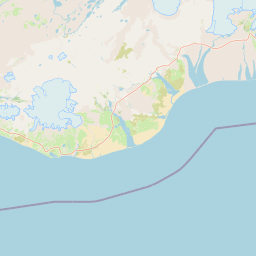
- OpenStreetMap contributors: base map and attribution for the five Highland locations in this article; geographic comparison only, not navigation, river or opening assurance.
- Hero image: Chmee2/Wikimedia Commons: Wading by car on Iceland (3), used under CC BY-SA 3.0; resized and converted to WebP by this site. The warning sign and vehicle in the photograph illustrate scale only and do not represent current water, road, vehicle or insurance conditions.
.jpg)
This is an L1 Highland river-crossing decision entry. It does not include unverified rental or activity CTAs: align road opening, vehicle and rental terms, the on-site exit and a safe fallback before moving to a checked driver-led activity, accommodation or transport page.