
Use fuel savings only after the route passes the practical test
For Reykjavík, the Golden Circle, the South Coast and Route 1, a petrol car is usually the simplest option to arrange. A hybrid is worth comparing when most of the driving stays on paved roads and fewer fuel stops would genuinely help. It does not remove refuelling, vehicle-class, luggage or winter constraints. If F-roads or four large suitcases are part of the plan, check road permission and boot space first; only then price the fuel difference. The route limits of 2WD and 4WD cover road eligibility; this page focuses on energy use and practical cost.
ICENAVI DRIVE FIT · PETROL OR HYBRID
Before chasing fuel savings, make sure the car can complete your route
These scores are an editorial judgement about vehicle-and-route fit, not a rental-company rating. Recheck the rental price, fuel use, station access, boot space, road eligibility, winter specification and return terms for your collection date.
1,322 kilometres is only the Ring Road baseline; put branch roads, detours, the day's fuel price and the rental-price difference into one formula to see whether the hybrid really pays back.
Both petrol cars and self-charging hybrids rely on fuel stations; checking N1 services, opening hours and payment in advance usually reduces more uncertainty than the vehicle name does.
Four large cases, boot shape, accommodation entrances and long stretches of Route 1 more often change each day's practical experience than saving a little fuel per 100 kilometres.
Heating, winter tyres, low temperatures, wind, snow and an early return all belong in the route plan; fuel figures cannot replace road conditions or a sensible fatigue limit.
A self-charging hybrid does not need charging; a PHEV adds value only when your accommodation and route genuinely support it. Plug-in range is not a fallback for the whole trip.
For Route 1 and town-based trips, compare the full rental price and luggage space first; upgrade only when the hybrid advantage covers the price gap and its vehicle permission is clear.
First separate the different kinds of hybrid
A rental page that says Hybrid may mean a self-charging hybrid or a plug-in hybrid (PHEV). A self-charging hybrid does not require you to find a socket; it recovers some energy at low speed, while slowing down and in stop-start town traffic. On long straight roads, into a headwind and at motorway speeds, its fuel advantage may not look as impressive as it does in city testing. Even if a PHEV can be driven like an ordinary petrol car, judge it against the rental company's guidance on charging, weight, boot space and permitted roads. Do not treat “has a battery” as shorthand for “better suited to Iceland”.
The most useful question is: “If I never charge it, can this car still complete today and tomorrow?” Only a yes gives you a real fallback. Blue Car Rental's FAQ also notes that some PHEVs can be driven like ordinary petrol cars, with the hybrid system assisting efficiency in the background. That is guidance for a vehicle family, not a promise for every supplier, model or winter route; check the contract and the actual vehicle class at booking.
| What you are really comparing | Petrol | Self-charging hybrid | PHEV |
|---|---|---|---|
| How you refuel | Find a station and refuel; timing is relatively predictable | Still uses fuel; does not depend on a charging station | Can use fuel; the value of charging depends on the accommodation and car |
| Short town trips | Simple, though stop-start driving still uses fuel | Usually makes better use of regenerative braking | May have an advantage on short trips, but adds weight and charging decisions |
| Long stretches of Route 1 | Plan around station locations | Plan around station locations; fuel use is not fixed | Plug-in range cannot replace a petrol fallback for the whole stretch |
| Most common failure point | Forgetting to refuel, using the wrong fuel or arriving late at a station | Treating the rental-page test figure as a safety limit | Assuming you can charge every night and overlooking contract restrictions |
Turn the Ring Road cost into two numbers, not just a daily rental price
Visit Iceland lists Route 1 as a circuit of about 1,322 kilometres; a real trip also adds drives to hotels, supermarkets and viewpoints, plus detours after a missed entrance and the airport transfer. Start with a plain but honest baseline: fuel volume = actual kilometres ÷ 100 × the rental company's L/100 km figure for that vehicle. Do not compare figures measured under different test standards.
Using only 1,322 kilometres, 6.0 L/100 km is about 79.3 litres and 8.0 L/100 km is about 105.8 litres: a difference of roughly 26.5 litres. Add 20% for fuelling, navigation and branch roads and the total becomes about 1,586 kilometres, widening the gap again. This page deliberately does not quote an “Iceland fuel price”, because prices change, and station brands and card pre-authorisations can affect how payment feels. Put the day's price into the formula; it is more useful than repeating an attractive but outdated figure.
| Driving situation | Starting assumption | Hidden costs to add | What this assumption cannot prove |
|---|---|---|---|
| Town + Golden Circle | Low mileage, frequent parking, concentrated refuelling | Town parking, short rental duration, collection and return transfers | That a hybrid is automatically better value than a cheaper petrol car |
| South Coast to Jökulsárlón | Include branch roads and travel between accommodation | Long headwind stretches, parking, late meals and station opening hours | That navigation mileage equals your actual total mileage |
| Complete Ring Road | 1,322 kilometres is only the baseline; add 15–25% for route extras | Cross-region detours, washing, tyre/glass cover and the final refuelling | That every season can cover the same distance in the same number of days |
| Winter or remote branch roads | Plan around a safely achievable short route, not maximum mileage | Early return, waiting, moving to a closer base and non-refundable losses | That half a tank guarantees a usable next station |
A fuel station is not just an abstract map pin. N1's station page can filter by region, fuel type, self-service, toilets, shop and EV charging. Before you leave, check what the station on tomorrow's route actually offers; that is more reassuring than seeing the brand name on a map. This is why I put the “last refuelling” beside the accommodation and the next day's direction, rather than waiting for the warning light. If you first encounter a pre-authorisation, card hold or failed self-service machine at the pump, see the payment timeline for Iceland fuel stations; keep vehicle fuel use separate from payment risk.
Put the route beside the price before choosing a car
| What your trip looks like | What I check first | Why | What not to let persuade you yet |
|---|---|---|---|
| Three to five days, town, Golden Circle and South Coast | The total petrol versus self-charging hybrid price, including fuel | Refuelling is relatively straightforward; the difference is often the car price and luggage | A promotional figure showing a little less per 100 kilometres |
| Seven to ten days, mainly Route 1, with two adults sharing the driving | The hybrid's boot, winter specification and actual collection class | One fewer fuel stop is a small convenience; whether the luggage fits is the daily difference | Treating “eco-friendly” as an answer about luggage capacity or safety |
| Four people with large luggage, often staying in remote areas | Boot shape, passenger space and fuel-station locations | Luggage that does not fit turns the back seat, visibility and parking into costs | A platform's “three bags” label, which has no consistent measurement standard |
| Highlands/F-roads or unclear rental wording | Road permission and insurance exclusions, then fuel | A car cannot become usable on a road you may not legally drive simply because it uses less fuel | The words SUV, Hybrid or 4x4 in the vehicle name |
Blue Car Rental's terms also remind renters to return the vehicle with the fuel/battery level specified at collection; wrong fuel, cleaning, tyres and road restrictions can all become extra charges. This is not a recommendation for one company. It is a reason to put “the moment you return the car” into today's cost: if the final night is too far away, leaving a sight early to find fuel can eat back any saving in time and changes to your plan.
When would I skip the hybrid outright?
If you are choosing a hybrid only because it “should use less fuel”, while the daily rental price is much higher, four cases cannot lie flat and your winter route requires an early return, I would skip it. The issue is not hybrids; that upgrade has not solved your most painful constraint. If most of your driving is in towns and at low speeds, your luggage is modest and the price gap is small, the hybrid's quieter drive and one fewer fuel stop may be a real convenience, even if it never saves the price of dinner.
Who should not use the formula on this page: anyone planning to change route every day, chase the far side of a closed road or treat an F-road like an ordinary highway. Start with how to read Iceland's road-condition website, the rental contract and accommodation you can cancel; if the road does not support the move, a per-100-kilometre figure has no decision value.
Before collection, ask these nine questions until the answers can be screenshotted
- Is the Hybrid you booked self-charging or a PHEV? How is the actual vehicle class described?
- Can the boot take every item of luggage you are bringing while lying flat, rather than just matching a bag count?
- What do the winter tyres, heating, screenwash and emergency equipment include?
- Can this car use every road on your route? Where are the F-road and gravel-road restrictions written?
- How will the fuel level, scratches, tyres and charging/fuel card be recorded at collection?
- Where is the nearest station before return, and have you checked its opening hours and payment method?
- How does the rental company handle low fuel, wrong fuel, excessive dirt and early return?
- If winter roads do not support the original route, can you move to closer accommodation?
- Once rental, fuel, parking, insurance and one recoverable buffer day are on the same sheet, which car is still worth choosing?
A practical choice for the last page of your comparison
Would the hybrid save enough to matter on your route?
A petrol car's strength is a straightforward refuelling routine; a hybrid can feel more relaxed on certain stretches. The soundest choice is usually the one that fits your boot, road eligibility, season and tolerance for changes, not the one with the lowest fuel figure. Write down the route and return terms first; only then does the vehicle deserve a comparison.
How do petrol, hybrid and plug-in hybrid cars match different Iceland routes?
For Route 1 only, is a hybrid always better value than petrol?
Not necessarily. Add the rental-price difference, daily mileage, station coverage, boot space and return process; a hybrid may buy you a more comfortable rhythm when the price gap is small and you do not want frequent fuel stops.
Can a hybrid be treated as an F-road vehicle?
Do not decide from the word “hybrid”. F-roads depend on the vehicle class explicitly permitted by the rental company, the drivetrain and that day's road conditions; without written permission, do not take it into the Highlands because its fuel figure is lower.
What does a winter fuel figure most easily leave out?
Heating, low temperatures, wind, snow, idling and detours increase consumption; keep both fuel and time in reserve, and check station hours and road conditions before setting out.
References
- Visit Iceland | The Ring Road (the length and Ring Road context; actual mileage still depends on your branch roads and accommodation).
- N1 | Gas stations in Iceland (station, fuel and service filters; recheck opening hours and payment before departure).
- Blue Car Rental | FAQ (PHEV, returns, road charges and supplier guidance; an example of terms, not every rental company).
- Blue Car Rental | Terms and conditions (fuel, vehicle, road and damage exclusions; your booking contract is final).
- SafeTravel | Fatigue and drowsiness (safety advice on fatigue, rest and stopping about every 100 kilometres).
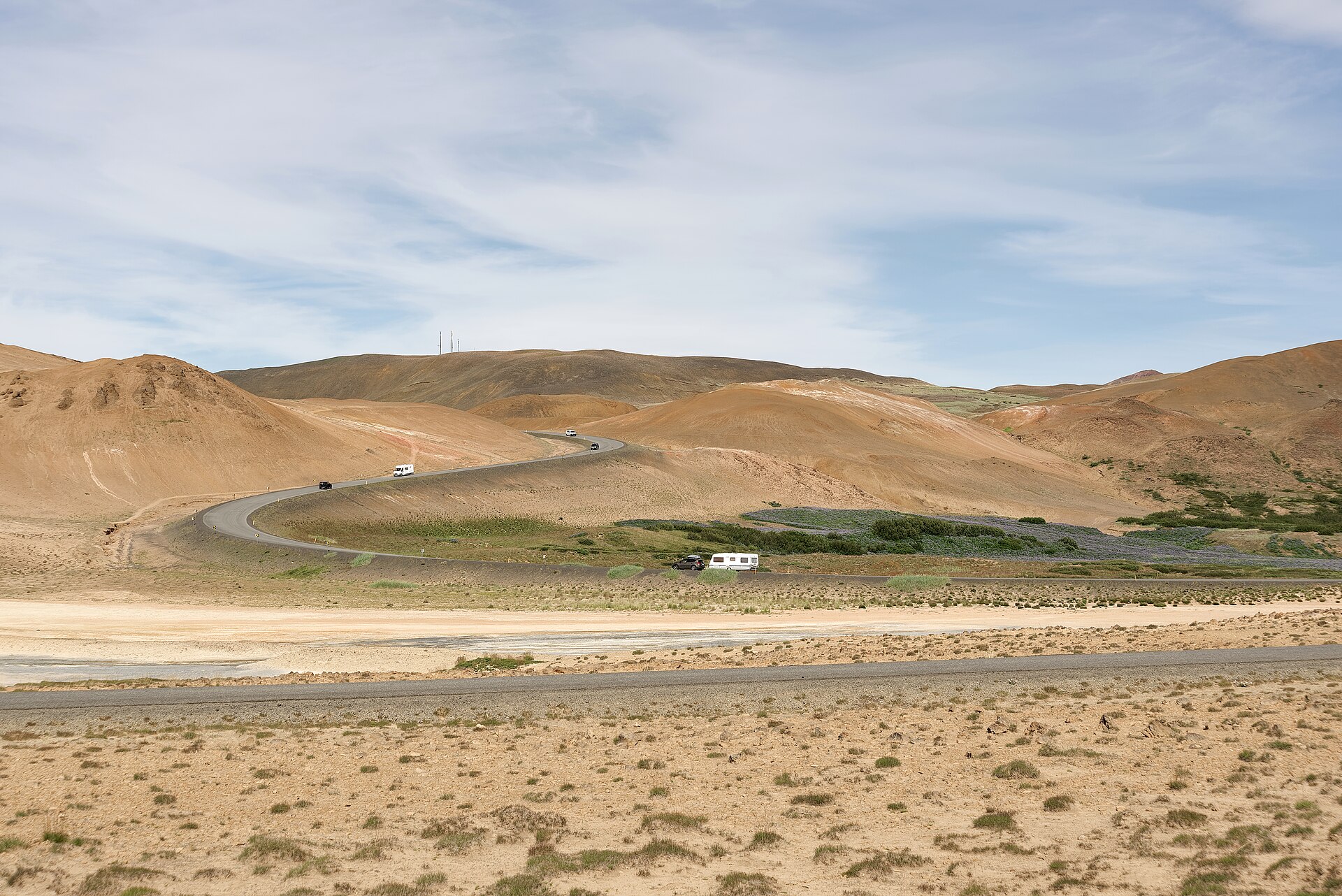
- Hero image: Jakub Halun/Wikimedia Commons, CC BY-SA 4.0; shown only as a road-environment illustration, not as same-day conditions, fuel consumption or a rental-supplier claim.