
ICENAVI · PAYMENT CLARITY
This guide will not tell you to carry a wallet full of cash, and it makes no promises on behalf of any bank. It has one job: when a terminal, fuel pump or hotel deposit appears in front of you, identify the wording you need to check next so you can distinguish a settled payment from an amount that is only being held temporarily.
Identify settlement, preauthorisation, deposits and DCC before judging the rate
Card payments are the easiest way to pay for everyday purchases in Iceland. Keep one physical card that can accept a PIN, plus a separate backup card. If a terminal offers Hong Kong dollars, US dollars or another familiar currency, look for ISK first, then compare your card network's rate and foreign transaction fee. Hotels, rental-car companies and fuel stations may place a preauthorisation before the final charge; that is not the same as a completed payment. Reykjavík parking must be handled according to the day's signs and the specified payment method. Check the status before judging the amount, so a hold does not look like an overcharge.
ICENAVI PAYMENT · CLARITY FIT
Is the amount you see a cost, or a temporary hold?
This score measures how traceable the original currency, DCC, preauthorisation, parking payment, receipts and backup-card arrangements are. It does not rate a bank, card or merchant; the actual terminal display, banking terms and merchant notice always take priority.
Keep the original ISK amount and receipt so you can compare them with your card network's rate and foreign transaction fee after returning home. A familiar Hong Kong dollar figure does not automatically mean a lower cost.
A hotel, rental car and N1 may all reserve available credit at the same time. Record the merchant, date, limit, release conditions and final posted transaction so you know when follow-up is needed.
Check the ISK amount, conversion rate and service fee on the terminal before deciding under your card's terms. Do not let “no extra fee” or a familiar currency make the choice for you.
Central zones, operating hours, number-plate entry, designated apps and minimum payments can change. Roadside fuel stations and urban parking are different payment situations, so check the day's instructions for both.
A physical backup card from a different issuer, its PIN, receipts and customer-service information can prevent one temporary hold from causing the next payment for the whole car to be declined.
Recognising the status, choosing the original currency, keeping receipts and protecting available credit usually prevents payment interruptions more effectively than chasing the lowest possible exchange rate.
Picture yourself at an N1 self-service pump. You enter your card PIN, but the screen does not immediately tell you how much fuel you have bought. Your banking app, however, shows a 22,000 ISK transaction. Someone travelling with you may ask, “Have they already charged us?” N1 explains that the amount is an upper-limit authorisation. Once fuelling is complete, the authorisation is cancelled and the actual amount dispensed is charged. Seeing two records temporarily does not mean the fuel has suddenly cost twice as much.
That same evening, the hotel may request a deposit or place another preauthorisation. If these statuses are not recorded separately, it is easy to assume that your card has “lost” a large amount of money and spend the credit you meant to keep for the rental-car deposit or an activity balance. The first payment question is not “Is it expensive?” It is “What does this line actually mean?”
Translate the payment screen into four statuses
I first place each line in a banking app into one of the four categories below. This is ICENAVI's payment status table, not a competition to translate banking jargon. The purpose is to show whether you need to act again while there is still time to resolve the issue.
| Screen / wording | What it usually means | What to do now | When to investigate |
|---|---|---|---|
| Pending / preauthorisation | The merchant has reserved an amount, but the transaction has not been finally settled | Record the date, merchant and amount; keep enough available credit | The amount remains unreleased beyond the period stated by the merchant or bank, or is completely inconsistent with the situation |
| Posted / settled | The transaction has reached the final charge, and the exchange rate and fees may now be fixed | Keep the receipt and compare the ISK amount, merchant name and card notification | The receipt and settled amount differ, or a merchant appears that you did not use |
| Deposit | A hotel or rental-car company is reserving credit for possible additional charges | Ask about the release conditions, expected timeframe and whether it will become a completed transaction | The hold remains after returning the car or checking out, or the merchant provides no explanation |
| HKD / USD payment option | The terminal is offering DCC, with the merchant or acquirer converting the amount first | Check whether ISK is available; compare your issuer's fees before confirming | Only after confirming do you discover an unreasonable rate, service fee or receipt currency |



The official exchange rate published by the Central Bank is a reference, not a guaranteed transaction rate for every card at every merchant. The final amount can also reflect the card network's rate, your issuer's foreign transaction fee and DCC offered by the merchant. An “instant conversion” figure is not automatically better value than your card's rate. Keep the original ISK amount on the receipt, or recalculating the transaction after returning to Hong Kong becomes difficult.

The 22,000 ISK fuel-station amount: a preauthorisation is not the fuel cost
An N1 self-service pump may preauthorise 22,000 ISK. After fuelling is complete, the authorisation is cancelled and the actual amount dispensed is settled. N1 also notes that release is usually quick, although it can take several days. During that period, a banking app may show a temporary hold alongside the actual transaction; that is not unusual. The figure comes from N1's official payment information as an example, not as a permanent amount that will apply to every station or card.
For that reason, do not use all of your available card credit on the first day of a self-drive trip. If a rental-car deposit is also in place, the fuel-station authorisation may overlap with temporary holds from the rental company and hotel. Before departure, save the Iceland fuel-station self-service guide for offline use. At the pump, confirm that your card accepts a PIN, understand how to cancel the operation, and keep the pump number or receipt after fuelling.
| When | What you may see | Do not mistake it for | Evidence to keep |
|---|---|---|---|
| Before fuelling | An authorisation limit / card verification | The actual fuel cost for this visit | Pump number, station name and the screen shown at the time |
| A few minutes after fuelling | The temporary record remains while an actual amount also appears | A duplicate charge | Litres dispensed, receipt and a screenshot of the banking notification |
| Several days later | The preauthorisation is released or disappears | The merchant failing to charge you | The final posted transaction and original-currency amount |
Hotel and rental-car deposits: they reserve credit, not extra holiday money
At check-in, a hotel may verify your card or reserve an amount. A rental-car company may also handle a deposit, fuel provision or damage liability according to its contract. The amount, release period and requirement for a physical card are controlled by the merchant's terms. Do not use another hotel's online estimate of “usually a few days” to predict what will happen here. Read the rental-car deposit and excess terms, then keep enough available credit for the days when you will actually need it.
I treat the group's available credit as a route resource, not as spare money simply because it may eventually be returned. If three people share one card and a hotel deposit, N1 authorisation and activity balance fall within the same day or two, the first problem may be a declined payment rather than an over-budget trip. Carry a backup card from a different issuer, and save customer-service numbers and card-blocking instructions offline. That is more useful than bringing several banknotes you may never spend.
When DCC appears, should you choose Hong Kong dollars? First decide which variable you want to control
Dynamic currency conversion (DCC) converts ISK into a familiar currency at the payment terminal. A familiar number can feel reassuring, but the Central Bank's consumer information warns that DCC often includes a service fee and may cost more than a conversion handled by your card network and issuer. Some cards, meanwhile, charge a fixed overseas fee or do not offer an especially favourable rate. “Always choose ISK” is therefore not a substitute for checking your card's terms.
Before pressing a button, ask three questions: will the receipt clearly show the original ISK amount? Does the terminal display the conversion rate and any fee? What does your card issuer charge for overseas transactions? If the information is incomplete, I would choose ISK, keep the receipt and compare it with the banking app later. Do not let the phrase “no extra fee” rush you into confirming. If the terminal gives you no choice, record what it displayed and ask your issuer about it after returning home.
| Payment situation | What to choose first | Costs to check | Receipt habit |
|---|---|---|---|
| Self-service fuel pump | Usually complete the authorisation and settlement in ISK | Authorisation limit, release period and foreign transaction fee | Photograph the pump number and final amount |
| Hotel / rental-car desk | Ask whether it is a deposit, preauthorisation or completed payment | Available credit, release conditions and additional services | Keep the check-in / return paperwork and time |
| Restaurant / shop terminal | Check the original ISK amount before deciding on DCC | Conversion rate, service fee and issuer's overseas fee | Keep the receipt and banking notification in the same album |
| Reykjavík parking | Follow the day's parking meter or designated-app instructions | Zone, operating hours, number-plate entry and minimum payment | Record the number plate, zone and end time |
Parking deserves separate attention. Central Reykjavík zones, operating hours and payment tools can change, so last year's guide cannot replace the sign in front of you. Visit Reykjavík provides city parking and service information; once you arrive, follow the parking meter, official app or local notice. If you are deciding whether a rental car is useful only outside the city, read how to arrange a rental car before and after Reykjavík rather than treating parking as an isolated small expense.
Tips and service fees: read the bill before letting a percentage on the screen decide for you
A payment terminal offering 10%, 15% or 20% does not mean that you must choose one of those percentages every time. Check whether a service fee is already listed on the bill, then decide according to the service you received and your budget. If you are unsure, politely ask, “Is this an optional tip, or is the service fee already included?” This guide does not make a cultural ruling for every restaurant or activity, because merchants display these options differently. The practical point is to avoid pressing the highest percentage while you still cannot read the original ISK amount.
ICENAVI Payment Clarity Score: four checks before a larger payment
Use this light scoring method as a final check before each substantial payment. Give each item 0–5 points. If the total is below 12, pause—not because the transaction is necessarily wrong, but because the information you have may not be enough to absorb a mistaken choice.
| Scoring item | What 5 points means | Common 0–2 point situation | Recovery action |
|---|---|---|---|
| Original-currency clarity | You can see the original ISK amount and have the receipt | Only a Hong Kong dollar total appears, with no conversion rate | Ask for the display again or choose ISK |
| Preauthorisation clarity | You know it is a hold, its limit and its release conditions | The merchant only says it will “hold” the money | Ask when it will be released and record the responsible merchant |
| Receipt traceability | Merchant, date, amount and vehicle or room reference are all recorded | You have only a phone notification, not a receipt | Take a screenshot and request an email or paper receipt |
| Fallback option | You have another card, its PIN and customer-service information | The group shares one card and has no offline contact number | Keep the backup card separately and save help information offline |
ICENAVI · PAYMENT DECISION
When an amount appears, do not immediately add it to your total spending.
First identify whether it is a settlement, preauthorisation, deposit or DCC conversion. Then keep the original-currency receipt and release conditions. You do not need to become a banking specialist; you only need to leave yourself a clear way to check the payment later. At a fuel station, protect available credit. At a hotel or rental-car desk, ask when the hold will be released. At a terminal, look for ISK first.
Eight payment checks before departure
- Carry at least one physical card that accepts a PIN, and check whether overseas transactions are disabled by default.
- Use a backup card from a different issuer and keep it separately from your main card.
- Confirm the hotel's and rental-car company's deposit and preauthorisation rules; do not replace the contract with vague answers from comment sections.
- Treat N1's 22,000 ISK authorisation as a temporary hold and leave enough available credit.
- Keep the original ISK amount, receipt and merchant name; do not save only the converted Hong Kong dollar figure.
- When DCC appears, ask about the conversion rate and service fee before comparing them with your card's terms.
- For parking, follow the day's meter, official app or local notice, and record the number plate, zone and end time.
- Save the bank, rental-car company, hotel and 112 contact details offline so you can still find the next step if the network fails.
The most unsettling part of paying in Iceland is often not the unfamiliar currency but one card carrying a fuel-station limit, hotel hold and unsettled activity charge on the same day. Separate the statuses and the statement stops looking like a list that has suddenly grown. For guidance on how much cash to carry, return to the cash and physical-card guide. If your next stop is a Reykjavík city day, open the Reykjavík city decision guide and consider parking, walking and rental-car days together.
Q&A | Which Iceland payment amounts should not be treated as travel expenses yet?
N1 shows 22,000 ISK. Have they already taken that amount?
An N1 self-service pump may place a preauthorisation first, then settle the actual fuel amount and release the difference after fuelling. That is a defined part of the payment process. Keep the receipt and available credit in mind, because release times vary between cards and banks.
A terminal asks whether I want to pay in Hong Kong dollars. What should I press?
Check the original ISK amount, conversion rate and service fee, then decide under your issuer's terms. A familiar Hong Kong dollar figure is not automatically cheaper. This is a cost decision that the terminal's “convenience” button cannot make for you.
Can Reykjavík parking use the same payment approach as a fuel station?
Do not assume so. Urban parking may depend on the zone, operating hours, number-plate entry or a designated app. The notice at the location is the controlling instruction. Preparing a backup card and offline contact information reduces the risk of an interrupted payment.
References
The following sources were compiled on 5 September 2026. Exchange rates, card fees, parking rules, merchant payment procedures and preauthorisation release times can vary by bank, merchant and date. Always follow the display and terms available at the time of payment.
- Central Bank of Iceland | Official exchange rate: the official rate is a reference and does not equal the transaction rate for every card.
- Central Bank of Iceland | Payment services: consumer information on foreign transaction fees, DCC, preauthorisations and payment services.
- N1 Iceland | Payment information: the 22,000 ISK authorisation at self-service pumps, cancellation after fuelling and release-time guidance.
- Visit Reykjavík | Before you visit: city parking, urban services and practical information before arrival; current charges and payment methods should be checked against official updates and local signs.
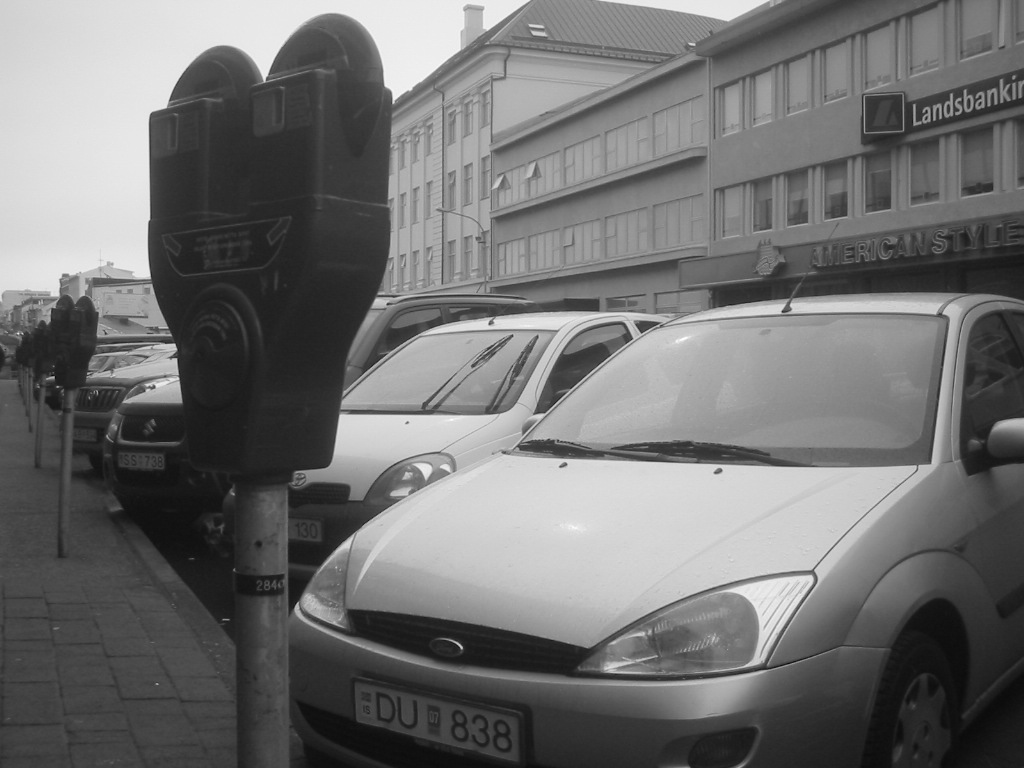
- Hero image: Helgi Halldórsson / Wikimedia Commons: Parking meter (485321925); this site uses the image only with resizing and cropping to illustrate an urban parking payment situation, not current rates, signs or parking availability.
.jpg)